



How To Make Your Website Ready For AI Search In 2026
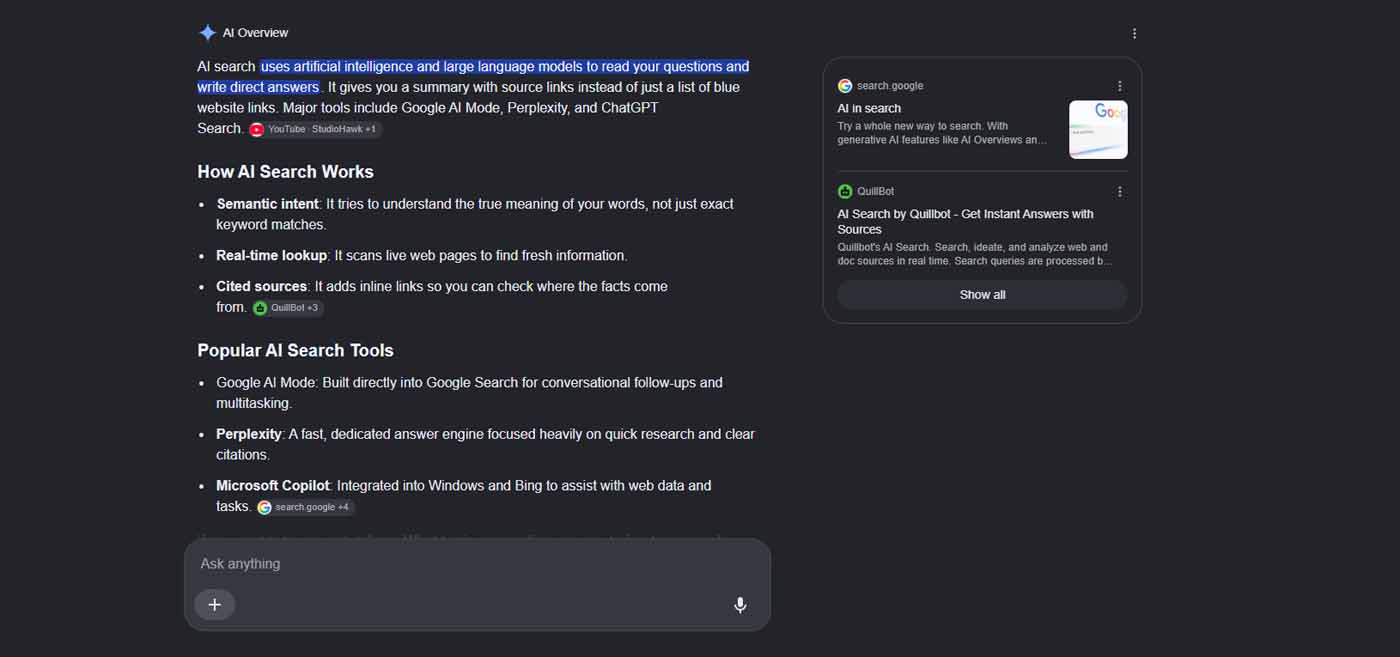
AI search has changed how people find information online.
That does not mean normal SEO is dead. It does mean business websites need to be clearer, better structured, and easier for search systems to understand. Google results are no longer only a list of blue links. People are seeing AI summaries, comparison-style answers, follow-up prompts, and search results that try to pull the useful part of a site forward before anyone clicks.
For NZ businesses, that creates a problem and an opportunity.
The problem is that vague websites are easier to ignore. If your content is thin, your services are unclear, your business details are inconsistent, or your site structure is messy, AI search tools have less to work with.
The opportunity is that a well-built website can become easier to understand. Clear services. Plain answers. Strong proof. Good structure. Human copy. Accurate details. These things matter even more now.
If you want your website ready for AI search in 2026, I would start here.
Make Your Core Services Obvious
AI search demands clarity.
So do people.
If your website makes users work too hard to understand what you do, search systems will struggle with the same issue. A lot of business websites bury their main services under vague headings, broad wording, or clever brand language that says very little.
That is weak.
Your core services should be easy to identify from the homepage, navigation, headings, and service content. If you are a web designer, roofer, accountant, builder, ecommerce store, or consultant, the website should say that plainly.
A strong website design NZ setup should not leave the visitor guessing. It should make the offer clear quickly, then support it with enough detail to build trust.
AI search does not reward confusion. Neither do customers.
Write Clear Answers To Real Questions
People search in questions now.
They ask Google, AI tools, and voice assistants things they might once have asked a business directly. That means your website needs to answer the questions your best customers are already thinking about.
Not vague FAQs for the sake of filling space. Real answers.
How much does it cost?
How long does it take?
What affects the quote?
Do you work in my area?
What happens after I enquire?
What makes one option better than another?
The stronger the answer, the easier it is for a person to trust you. It also gives search systems a clearer explanation of what your business knows.
A lot of websites still avoid answering practical questions because they want the enquiry first. That can backfire. If a competitor answers clearly and you do not, they often feel easier to choose.
Structure The Site So Topics Are Easy To Follow
Website structure matters a lot in AI search.
A messy website makes everything harder to interpret. Services overlap. Blog topics float around with no clear connection. Local content feels tacked on. Important sections sit too deep. Internal links point randomly or barely exist.
A clean structure helps humans move through the site, but it also helps search systems understand what the business is about.
That means your main services should have clear dedicated sections. Supporting articles should connect to those services. Local content should make sense. Navigation should be simple. Important content should not be hidden three clicks away with no internal support.
The approach in how to structure your website for SEO in 2026 becomes even more important as AI search grows. Structure gives the content a clearer shape.
Use Plain Language, Not Empty Marketing Copy
AI search is another reason to stop writing generic website copy.
Phrases like “tailored solutions”, “customer-focused service”, and “high-quality results” do very little unless they are supported by specifics. They sound tidy, but they do not explain much.
Plain language works better.
Say what you do. Say who it helps. Say what the process looks like. Say what makes the job easier, safer, faster, or better for the customer. Use the kind of wording a real person would understand.
That does not mean dumbing things down. It means cutting the filler.
A guide like how to write website copy that sounds human and still ranks fits neatly here because AI search does not remove the need for human writing. It raises the cost of bland writing.
Keep Business Information Accurate Everywhere
AI search tools often pull context from across the web.
That makes consistency important.
Your business name, services, locations, contact details, opening hours, and key claims should be accurate across your website and other public profiles. If your site says one thing, your Google Business Profile says another, and old content says something else, you create confusion.
This is especially important for local NZ businesses.
If you serve Auckland, say where in Auckland. If you work nationwide, make that clear. If you have specific service areas, keep them consistent. If you no longer offer something, remove or update it.
Old content can quietly create the wrong impression. A content refresh is often less exciting than a new campaign, but it can clean up a lot of weak signals.
Add Proof That Supports Your Claims
AI search may summarise information, but people still need trust before they enquire.
That means your website should not rely on claims alone.
Use project examples, testimonials, case studies, reviews, before and afters, industry experience, accreditations, or process detail where they fit naturally. The goal is to show that your business can do what it says.
If the website says you build strong ecommerce stores, show examples. If you say you help local service businesses get better enquiries, show how. If you say your process is clearer than most, explain it.
Proof gives both visitors and search systems better context.
The ideas in how to use case studies and project proof to win website enquiries are useful here. Real evidence makes a website much harder to dismiss.
Do Not Chase “AI SEO” Tricks Too Early
There will be plenty of people selling shortcuts.
Most businesses do not need that first.
Before chasing AI-search tactics, fix the basics. Make the site fast. Make it easy to crawl. Clean up the structure. Improve weak content. Add real answers. Use clear headings. Keep business information accurate. Build trust with proof. Make mobile usability strong.
That work is not glamorous, but it is what gives AI search something useful to read and understand.
If the website is vague, slow, thin, or poorly structured, no fancy AI optimisation layer will save it properly.
AI Search Rewards Websites That Explain Themselves Well
That is the simplest way to think about it.
Your website needs to explain the business clearly enough for a human to trust it and for search systems to understand it. Those two goals are now sitting closer together.
Strong AI search readiness is not about writing for robots. It is about making your content cleaner, clearer, better supported, and easier to interpret.
For NZ businesses, that is good news.
Most competitors still have messy websites, thin service content, weak proof, and generic copy. Fix those things properly and you give your site a better chance, whether the visitor finds you through a standard result, an AI summary, or something else coming next.
Comments are closed.